Saudi End of Service Benefits (Gratuity): How It's Calculated in 2026
A plain-language guide to how Saudi end-of-service benefits (gratuity) are calculated in 2026, how resignation vs termination changes your payout, and how to work out your exact figure.
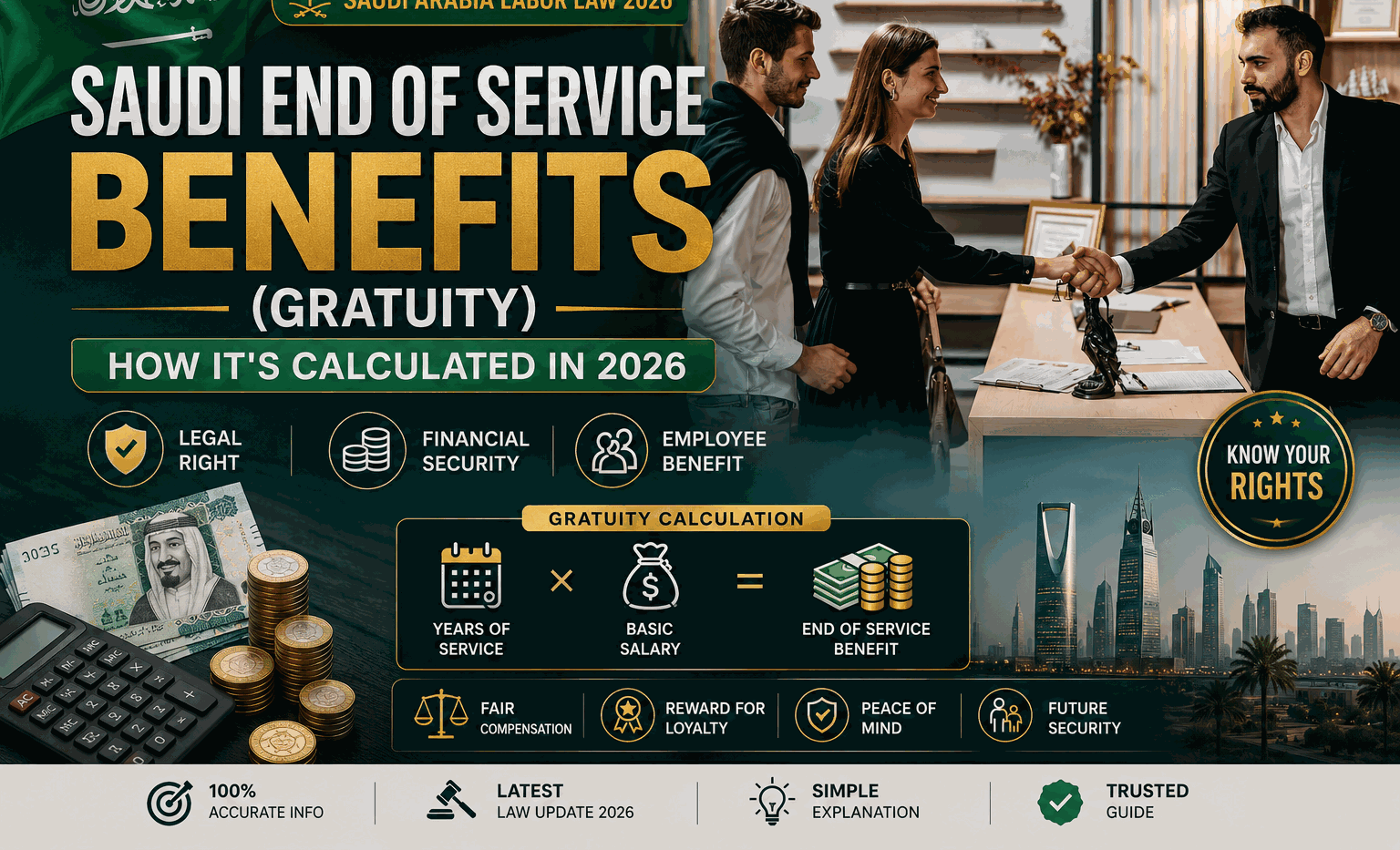
If you work in the private sector in Saudi Arabia, your end-of-service benefit (known as gratuity, or mukafat nihayat al-khidma) is one of the most valuable payments you will ever receive from an employer. Yet many workers have no idea how it is calculated until the day they leave, and some lose thousands of riyals simply because they resigned at the wrong time. This guide explains, in plain language, how Saudi end-of-service benefits work in 2026, what changes your final amount, and how to estimate your own figure before you sign anything.
What are Saudi end-of-service benefits?
End-of-service benefits (EOSB) are a lump sum your employer must pay you when your employment ends, based on how long you worked and your final wage. It is a legal right for private-sector workers under the Saudi Labor Law, and it applies equally to Saudi and non-Saudi employees. The rules are set out mainly in Articles 84, 85 and 87 of the law, so your entitlement does not depend on your employer's goodwill, it is defined by statute.
How the gratuity is calculated
The core formula is simple once you see it broken into two parts:
- First 5 years of service: half a month's wage for each year.
- From year 6 onward: one full month's wage for each additional year.
Your award is based on your last wage, not your starting salary, and you are entitled to a pro-rata amount for any part of a year you worked. There is no maximum cap on the total.
Resignation vs termination: this changes everything
The single biggest factor after your salary is why your employment ended. If your employer ends the contract (and not for a disciplinary reason), you generally receive the full award calculated above. But if you resign, the amount is reduced on a sliding scale based on your total years of service, under Article 85:
- Under 2 years: no gratuity at all.
- 2 to 5 years: you receive one-third of the award.
- 5 to 10 years: you receive two-thirds of the award.
- 10 years or more: you receive the full award.
This is exactly why timing matters. An employee who resigns just before completing 5 years gets one-third, while waiting a little longer can move them to two-thirds. Knowing where you sit on this scale before you hand in your notice can be worth a great deal of money.
A simple worked example
Imagine a worker whose last wage is 6,000 SAR a month, who completes exactly 8 years of service and is then terminated by the employer (so the full award applies):
- First 5 years: 5 × half a month = 2.5 months of wage.
- Years 6 to 8: 3 × one full month = 3 months of wage.
- Total: 5.5 months × 6,000 SAR = 33,000 SAR.
If that same worker had resigned instead of being terminated, the 5-to-10-year band would apply, so they would receive two-thirds of 33,000, which is about 22,000 SAR. That is roughly 11,000 SAR of difference from one decision alone.
What counts as your "wage" for the calculation?
Under the Saudi Labor Law, the award is based on your last "wage", which typically means your basic salary plus regular fixed allowances such as housing and transport, rather than basic salary alone. Because different contracts define allowances differently, always check your own contract and payslip, since this single point can noticeably change your final figure.
Special cases worth knowing
- Fractions of a year are paid pro-rata, so 6 extra months earns half of that year's entitlement.
- Female workers may be entitled to the full award even on resignation if they leave within 6 months of marriage or 3 months of giving birth (Article 87).
- Force majeure (leaving for reasons genuinely beyond your control) can also entitle a resigning worker to the full award.
- Probation period: if the contract ends during probation, gratuity is generally not payable unless your contract says otherwise.
When and how you get paid
Your end-of-service benefit is normally settled as a lump sum as part of your final settlement when you leave. Along with the gratuity, you are also entitled to payment for any accrued and unused annual leave. If you and your employer disagree over the amount, start with your HR department, and if it stays unresolved you can raise it with the labor authorities.
Work out your exact figure
The formula is straightforward, but the resignation tiers and pro-rata fractions make manual maths easy to get wrong. The quickest way to see your number is to use our free Saudi End-of-Service Calculator: enter your last wage, your years of service, and whether you resigned or were terminated, and it applies the correct rates for you. If you are also planning your exit, our Iqama Fees Calculator can help you budget the other costs of your final months in the Kingdom.
Once your gratuity is paid, many workers send a large part of it home. Before you transfer, it is worth comparing providers so you do not lose a chunk of it to a poor exchange rate. Our guide on how to send money from Saudi Arabia to Pakistan and the Remittance Cost Calculator can help you keep more of what you earned.
End-of-service benefits are a right you have earned, so it pays to understand them well before your last day. The figures here follow the Saudi Labor Law as it stands, but your exact entitlement depends on your contract and your specific circumstances, so treat this as a guide and confirm the final amount with your employer or the labor authorities.